TakeHomeTax

RMD Forecaster

By NumbersLab · Updated 2026

Year-by-year Required Minimum Distribution projection using the actual IRS Uniform Lifetime Table. Compare a Roth conversion ladder against do-nothing — see how much lifetime federal tax each strategy costs.

Tax Year
RMD starts at 75 based on birth year
$
%
federal taxable income before RMDs
$
Roth Conversion Ladder (alternative scenario)
$
will run from age 62 through age 71
Conversion Saves Federal Tax
$215,209Conversion ladder strongly favorable
Across age 62 → 95 (34 years modeled)
No Conversions: Total Tax
$812,397
Federal only
With Conversions: Total Tax
$597,188
Federal only
Total Lifetime RMDs (no conv.)
$4,545,215
Age 75 → 95
Total Converted
$500,000
Moved to Roth
Note: federal tax only. State tax, NIIT, IRMAA, and Social Security cascade not modeled here — they typically increase the conversion benefit further by reducing RMD-year income exposure.

Year-by-Year Projection

AgeIRS DivisorNo-Conv BalanceNo-Conv RMDNo-Conv TaxConv Strategy: ConversionConv Strategy: RMDConv Strategy: Tax
62$1.5M$50,000$5,660
63$1.6M$50,000$5,660
64$1.7M$50,000$5,660
65$1.8M$50,000$5,660
66$1.9M$50,000$5,660
67$2.0M$50,000$5,660
68$2.1M$50,000$5,660
69$2.3M$50,000$5,660
70$2.4M$50,000$5,660
71$2.5M$50,000$5,660
72$2.7M
73$2.8M
74$3.0M
7524.6$3.2M$130,057$19,082$96,235$11,642
7623.7$3.3M$137,278$20,671$101,578$12,817
7722.9$3.3M$144,244$22,204$106,733$13,951
7822.0$3.3M$152,204$23,955$112,622$15,247
7921.1$3.4M$160,571$25,796$118,814$16,609
8020.2$3.4M$169,363$27,730$125,319$18,040
8119.4$3.4M$177,674$29,558$131,469$19,393
8218.5$3.5M$187,317$31,680$138,604$20,963
8317.7$3.5M$196,312$33,659$145,260$22,427
8416.8$3.5M$206,852$36,012$153,059$24,143
8516.0$3.5M$216,522$38,333$160,214$25,717
8615.2$3.4M$226,494$40,727$167,593$27,340
8714.4$3.4M$236,749$43,188$175,181$29,010
8813.7$3.4M$245,458$45,278$181,625$30,428
8912.9$3.3M$256,152$47,845$189,538$32,168
9012.2$3.2M$264,844$49,931$195,970$33,583
9111.5$3.1M$273,412$51,987$202,309$34,978
9210.8$3.0M$281,766$53,992$208,491$36,406
9310.1$2.9M$289,800$55,920$214,436$37,833
949.5$2.8M$294,254$56,989$217,731$38,624
958.9$2.7M$297,891$57,862$220,423$39,269
About the IRS Uniform Lifetime Table
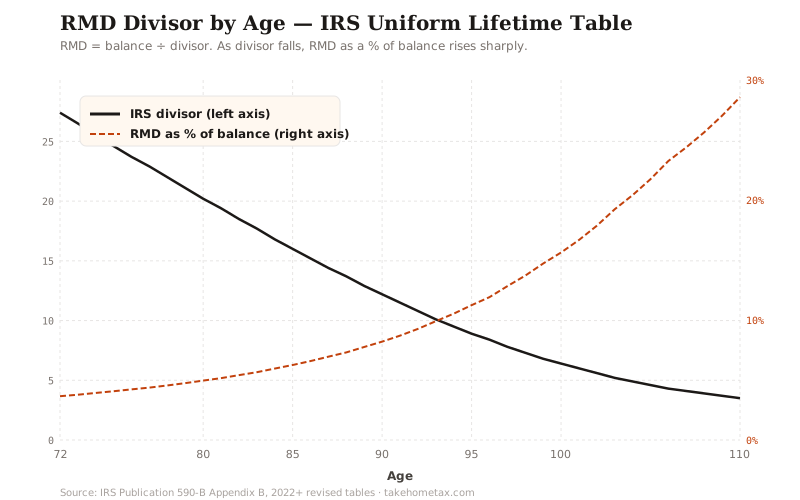
The divisors above come from IRS Publication 590-B, Appendix B (the 2022+ Uniform Lifetime Table). Divisor at age 73 is 26.5 — so a $1M IRA at age 73 requires an RMD of $37,736 that year. At age 80 the divisor drops to 20.2 — same $1M balance would force $49,505 out. Divisor at age 95 is 8.9 — RMDs become a major fraction of the remaining balance.

How This Works

Required Minimum Distributions (RMDs) force pre-tax retirement assets out of Traditional IRAs and 401(k)s starting at age 73 (or 75 for those born 1960+). Each year's RMD is your account balance divided by an IRS-published divisor from the Uniform Lifetime Table. The divisor decreases with age, so RMDs become a larger fraction of your balance every year.

The problem: by the time RMDs kick in, your IRA balance has typically grown to the point where forced distributions push you into much higher brackets than you might be in otherwise. Combined with Social Security taxation, IRMAA brackets, and NIIT, the effective marginal rate on RMD income often exceeds 30-40%.

The solution: convert Traditional IRA assets to Roth IRA during the lower-bracket years between retirement and RMD start (typically age 60-72). Each conversion shrinks the future RMD-paying balance and moves money into the never-taxed Roth structure. The conversion ladder pays tax now (at lower rates) to avoid paying more tax later (at higher rates).

This calculator uses the actual 2022+ IRS Uniform Lifetime Table divisors and 2026 federal brackets. It projects year-by-year through age 95 under two scenarios: no conversions (RMDs as forced), and an annual conversion ladder you specify. The federal tax delta tells you whether the conversion strategy pays off for your specific numbers.

Frequently Asked Questions

What is the Roth conversion ladder strategy?+
A Roth conversion ladder is a multi-year plan to systematically convert Traditional IRA balances to Roth during the low-income window between retirement and RMD age (typically age 60-72). Each year, you convert just enough to fill the 12% or 22% federal bracket without triggering IRMAA tier increases. Over a decade, this can shift $500,000-$1,000,000 from Traditional to Roth at favorable tax rates, dramatically reducing the future RMD-paying balance. The conversion is taxable in the year it occurs, but the Roth balance then grows tax-free forever with no RMDs. Pair this calculator with the RMD Forecaster to see lifetime federal tax savings.
When should I do a Roth conversion?+
The optimal window is typically age 60-72: after retirement (no W-2 income), before Required Minimum Distributions begin (so you have flexibility on how much to convert), and ideally before claiming Social Security (which would push provisional income higher and expose more benefits to taxation). Convert in years your projected income is lowest. Avoid converting in years with large capital gains, since the conversion plus gains may push you over NIIT or IRMAA thresholds. For most retirees, the optimal annual conversion amount fills the top of the 12% or 22% federal bracket without crossing into 24%+.
How much should I convert to Roth each year?+
Most retirees should convert just enough to fill their current federal bracket without triggering IRMAA tier increases. For 2026, the 12% bracket tops at $99,700 taxable income for married filers ($49,850 single). The 22% bracket tops at $212,900 married ($106,450 single). The first IRMAA tier triggers at $212,000 MAGI for married filers. Run scenarios at $50K, $100K, $150K, and $200K annual conversion to see the lifetime tax delta — the right answer depends on your projected RMD-age income, your portfolio size, and your state tax exposure.
Do Roth conversions affect Medicare premiums?+
Yes. Medicare Part B and Part D premiums are means-tested via Income-Related Monthly Adjustment Amounts (IRMAA) based on your Modified Adjusted Gross Income (MAGI) from two years prior. In 2026, the first IRMAA tier hits at $212,000 MAGI for married filers, adding about $84/month per person to Part B premiums. Higher tiers add $200-$400+/month. A large Roth conversion can push you into a higher IRMAA tier for one year. Mitigation: spread conversions across multiple years to stay below tier thresholds, or accept one year of higher IRMAA in exchange for years of lower RMD-driven IRMAA later.
Can I do a Roth conversion at any age?+
Yes — Roth conversions have no age limit and no income limit (unlike direct Roth IRA contributions, which phase out at higher incomes). You can convert at age 25, 60, or 85. The optimal timing is typically when you're in a lower tax bracket than you expect to be later, which for most retirees means the gap between retirement and RMD age. Once you start taking RMDs at 73-75, conversions become less attractive because you're already in higher brackets and the conversion stacks on top of the forced RMD.

More Tax Tools

PaycheckFreelance TaxOvertime (OBBBA)Quarterly EstimatesBonus TaxW-4 WithholdingTax RefundStock OptionsRSU TaxSelf-EmploymentSide IncomeRetirementSalary → HourlyHourly → SalaryMarriage TaxRelocationCost of LivingEmployer CostCapital Gains1099 vs W2Social SecurityPaycheck PlannerSalary NegotiationRetirement PlannerBracket VisualizerSide HustleTotal CompAMT TriggerCharitable GivingWithdrawal SequencerTrue Marginal RateTax Cliff MapSS Claiming AgeLump Sum vs AnnuityInherited IRARMDInflation SalaryRoth vs Traditional 401kHSA Triple-Tax
Sponsored
Recommended Reading
Disclosure
Retirement Financial Planning Guidebook
by Gordon Wells
Plain-language walkthrough of building retirement security — savings strategies, withdrawal timing, and avoiding common late-career mistakes.
View on Amazon →
Retirement Planning Guidebook
by Wade Pfau, PhD
Researcher-grade reference on the entire retirement-income decision: Social Security claiming, withdrawal rates, annuities, tax-efficient sequencing.
View on Amazon →
Living Trusts, Retirement & Estate Planning
by Estate Planning Guide
Step-by-step on integrating retirement accounts with living trusts, beneficiary designations, and inheritance tax planning.
View on Amazon →
The Take-Home Tax Guide
Weekly tips on reducing your tax burden, state tax changes, and salary negotiation strategies. Free.