Monday, June 15, 2026·2026 Edition
AboutMethodologyContact
The TakeHomeTax
Home/Calculators/Paycheck Calculators
Paycheck Calculators

Paycheck Calculator

Calculate your exact net pay per paycheck after federal income tax, state tax, FICA, and pre-tax deductions. See how 401(k), HSA, and health insurance contributions affect each paycheck.

By NumbersLab Editorial·Updated for 2026 tax year·Editorial standards
Calculator with coins for take-home pay — representing federal, state, and FICA tax breakdown on every paycheck
Photo by Towfiqu barbhuiya on Unsplash
Interactive Calculator

All inputs adjust the result in real time. No data leaves your browser.

Tax Year
$
Pre-Tax Deductions (Annual)
$
$
$
Net Pay Per Paycheck
$2,36717.9% effective rate
Biweekly — $61,538/year after all taxes & deductions
Gross Per Paycheck
$2,885
Federal Tax / Check
$297
FICA / Check
$221
SS $179 + Med $42
State Tax / Check
$0
No state income tax
Per-Paycheck Breakdown
Gross Pay$2,885
Federal Income Tax−$297
FICA (SS + Medicare)−$221
Texas State Tax$0
Net Pay$2,367
Annual Summary
Gross Salary$75,000
Federal Income Tax−$7,725
FICA (SS + Medicare)−$5,738
Texas State Tax$0
Total Taxes$13,463
Annual Take-Home$61,538
Monthly Take-Home$5,128
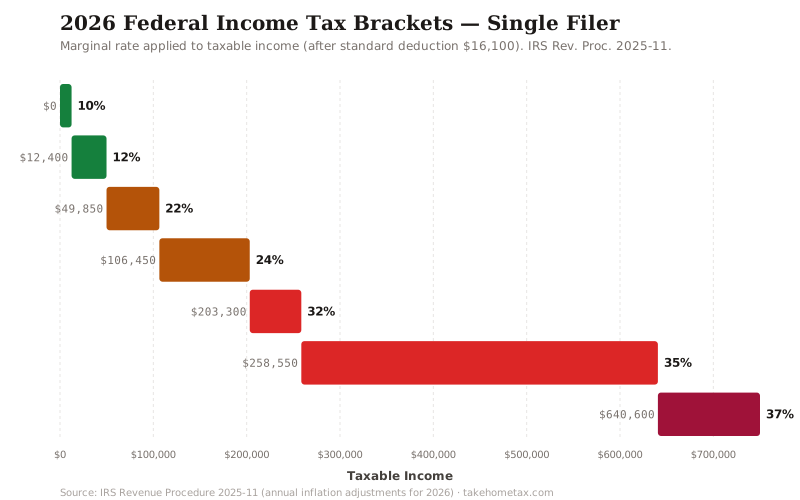
2026 federal income tax brackets for single filers showing marginal rates from 10% to 37% across taxable income from $0 to $750,000
Figure. The 2026 federal marginal tax brackets for single filers. The 22% bracket spans the largest income range ($49,850–$106,450), so most middle-class filers spend years adding income inside it.Source: IRS Revenue Procedure 2025-11
The Background

Your net paycheck is your gross pay minus taxes and pre-tax deductions. Understanding exactly what comes out of each paycheck helps you budget accurately and avoid surprises.

Pre-tax deductions like 401(k) contributions, HSA contributions, and health insurance premiums are subtracted from your gross pay before federal and state income taxes are calculated. This lowers your taxable income, meaning you pay less in income tax. However, these deductions do not reduce your FICA (Social Security and Medicare) taxes.

FICA taxes are calculated on your full gross salary regardless of pre-tax deductions. Social Security tax is 6.2% on earnings up to $184,500, and Medicare tax is 1.45% on all earnings (plus an additional 0.9% on earnings above $200,000).

Pay frequency affects the size of each paycheck but not your total annual tax burden. Weekly pay means 52 smaller paychecks, biweekly means 26, semi-monthly means 24, and monthly means 12 larger paychecks. The annual totals remain the same regardless of frequency.

Frequently Asked
How is my paycheck calculated?+
Your gross paycheck is your annual salary divided by pay periods (24 semi-monthly, 26 biweekly, 52 weekly). From that, the calculator subtracts: federal income tax withholding (based on your W-4), Social Security tax (6.2% on wages up to $184,500 in 2026), Medicare tax (1.45% on all wages plus 0.9% Additional Medicare on wages over $200,000), state income tax (varies by state — 9 states have no tax), local tax if applicable (NYC, Philadelphia, many Ohio cities, Maryland counties, etc.), and pre-tax deductions like 401(k), HSA, and health insurance premiums.
How much taxes are taken out of my paycheck?+
Federal withholding plus FICA (Social Security + Medicare) typically takes 18-30% of gross pay before state and local tax. For a $75,000 single filer in 2026: federal withholding ~$8,970/year, FICA $5,737, totaling 19.6% federal. Add California state tax of about $3,000 (4.0% effective) and you're at 23.6% combined. In Texas with no state tax, same income would be 19.6%. High earners hit higher marginal brackets — at $200,000 single, combined federal+FICA is closer to 30%, plus Additional Medicare Tax of 0.9% on wages over $200,000.
What is the difference between gross and net pay?+
Gross pay is your full earned wages before any deductions. Net pay (take-home pay) is what hits your bank account after federal income tax withholding, FICA (Social Security + Medicare), state income tax, local tax, and voluntary pre-tax deductions like 401(k), HSA, and health insurance premiums. The gap between gross and net is typically 25-35% of gross pay depending on state and contribution choices. Pre-tax 401(k) and HSA contributions reduce taxable income, which reduces the tax taken out — so increasing those can grow your net pay less than the contribution amount.
How do I increase my take-home pay?+
Three main levers: (1) reduce taxable income via pre-tax contributions to 401(k), HSA, FSA, dependent-care FSA, and commuter benefits — each dollar contributed saves you your marginal tax rate on that dollar; (2) update your W-4 to match actual withholding to actual tax owed — most refunds are interest-free loans to the government, and adjusting allowances brings cash flow into each paycheck instead of one annual refund; (3) move to a no-tax state (Texas, Florida, Tennessee, Washington, Nevada, Wyoming, South Dakota, New Hampshire, Alaska) — at $100K income this saves $3,000-$9,000/year compared to high-tax states.
What state has the highest take-home pay?+
The 9 no-income-tax states all share the top tier for take-home pay: Alaska, Florida, Nevada, New Hampshire, South Dakota, Tennessee, Texas, Washington, and Wyoming. On a $100K salary, these states give you about $78,900 take-home vs $72,400 in California — a $6,500 annual gap. Of the income-tax states, those with the lowest take-home impact are typically Pennsylvania (3.07% flat), Indiana (2.95% flat), and Ohio (2.75% flat). Cost of living matters too — Texas has high property taxes, Washington has high sales tax (10%+), so the no-tax savings are partially offset by other taxes.
More in Paycheck Calculators
Browse all paycheck calculators
The Full Index
Freelance TaxOvertime (OBBBA)Quarterly EstimatesBonus TaxW-4 WithholdingTax RefundStock OptionsRSU TaxSelf-EmploymentSide IncomeRetirementSalary → HourlyHourly → SalaryMarriage TaxRelocationCost of LivingEmployer CostCapital Gains1099 vs W2Social SecurityPaycheck PlannerSalary NegotiationRetirement PlannerBracket VisualizerSide HustleTotal CompAMT TriggerCharitable GivingWithdrawal SequencerTrue Marginal RateTax Cliff MapRMD ForecasterSS Claiming AgeLump Sum vs AnnuityInherited IRARMDInflation SalaryRoth vs Traditional 401kHSA Triple-Tax401(k)
Was this calculator helpful?
The Take-Home Tax Guide
Weekly tips on reducing your tax burden, state tax changes, and salary negotiation strategies. Free.