RMD Calculator
Calculate your exact required minimum distribution for 2026 using the actual IRS Uniform Lifetime, Joint Life, and Single Life Expectancy tables. Includes federal and state tax breakdown plus Qualified Charitable Distribution (QCD) reduction.

All inputs adjust the result in real time. No data leaves your browser.
A Required Minimum Distribution (RMD) is the amount the IRS forces you to withdraw each year from Traditional IRAs, 401(k)s, 403(b)s, and most other pre-tax retirement accounts once you reach the RMD start age. RMDs do not apply to Roth IRAs during your lifetime. They do apply to Roth 401(k)s through 2023 but were eliminated for Roth 401(k)s by SECURE 2.0 starting in 2024.
Your RMD start age depends on your birth year. Born 1949 or earlier: age 72. Born 1950-1959: age 73. Born 1960 or later: age 75. The first RMD can be delayed until April 1 of the year after you turn the start age, but doing so means taking two RMDs in that year — usually a tax-inefficient choice. Every subsequent RMD is due by December 31.
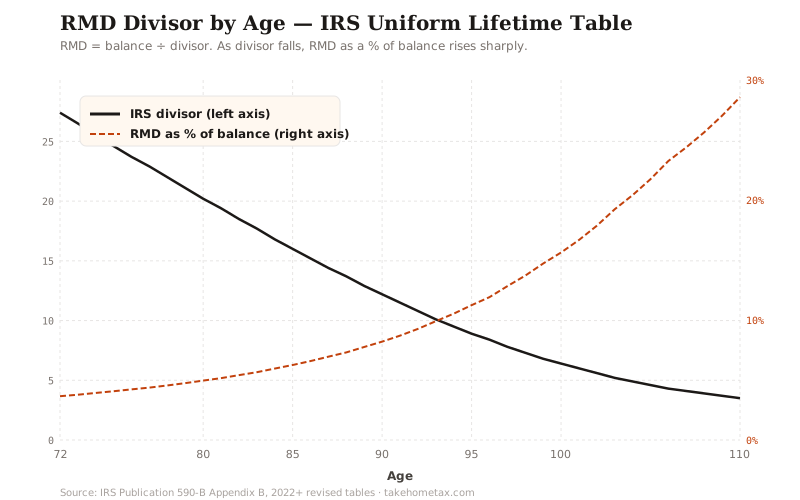
The math is simple: RMD = account balance on December 31 of the prior year ÷ IRS divisor for your age. The divisor comes from one of three tables. The Uniform Lifetime Table covers most retirees. The Joint Life and Last Survivor Expectancy Table is required when your spouse is the sole beneficiary AND more than 10 years younger — it produces a larger divisor (smaller RMD). The Single Life Expectancy Table applies to inherited IRAs.
Multiple IRAs are aggregated for RMD purposes — calculate the RMD for each, then take the total from any one or combination of your IRAs. Multiple 401(k)s are NOT aggregated — each plan requires its own RMD taken separately from that plan. 403(b)s follow the IRA-style aggregation rule. Inherited IRAs cannot be aggregated with your own IRAs and must be tracked separately.
Qualified Charitable Distributions (QCDs) let you direct up to $108,000 in 2026 ($105,000 in 2025) from your IRA directly to qualified 501(c)(3) charities. The QCD counts toward your RMD but is excluded from your AGI — meaning it doesn't push you into higher brackets, doesn't increase IRMAA Medicare surcharges, and doesn't make more of your Social Security benefits taxable. QCDs are available starting at age 70½ (not 73), making them a powerful charitable-giving tool even before mandatory RMDs begin. Inherited IRAs are not eligible for QCDs.
Missing an RMD triggers a 25% excise tax on the shortfall under SECURE 2.0 — reduced from 50% in 2022. If corrected within two years, the penalty drops further to 10%. File Form 5329 with your return to report and pay the penalty, or to request a waiver if you have reasonable cause.