TakeHomeTax

Roth vs Traditional 401(k) Calculator

By NumbersLab · Updated 2026

Compare Roth and Traditional 401(k) contributions using actual 2026 federal tax brackets and your projected retirement income — not a hand-waved 'future tax rate.' Models RMD-driven retirement income, real marginal rate at each level, and lifetime after-tax dollars under each strategy.

30 years to invest
2026 limit: $23,500
$
for marginal rate calc
$
top marginal rate
%
net of fees
%
Retirement Scenario
total taxable income at withdrawal
$
state you'll live in then
%
Invest Traditional's tax savings in taxable
Most people spend the savings. If you actually invest them (perfect execution), Traditional nearly equalizes Roth at the same rate.
Roth 401(k) Wins
$340,059Roth clearly favored (+22.0%)
After-tax retirement value gap
Roth Balance @ Retirement
$1.9M
All tax-free withdrawals
Traditional Balance @ Retirement
$1.9M
Pre-tax — must pay income tax
Current Marginal (Fed + State)
28.0%
Fed: 22.0% · State: 6.0%
Retirement Marginal (Fed + State)
18.0%
Fed: 12.0% · State: 6.0%
Why Roth Wins Here
Your current marginal rate (28.0%) is meaningfully higher than your projected retirement rate (18.0%). Taking the deduction now at the high rate and paying tax later at the lower rate is classic rate arbitrage — Traditional captures it.

What This Calculator Doesn't Model

RMD-driven bracket creep: Traditional balances above ~$1M trigger RMDs that push retirees into higher brackets than this calculator's static retirement rate. Use the RMD Forecaster to see year-by-year impact.

Social Security tax torpedo: Traditional withdrawals add to provisional income, exposing up to 85% of SS benefits to taxation. Effective marginal rates jump 10-20 points in this zone. Roth withdrawals don't.

IRMAA Medicare surcharges: Higher Traditional withdrawals can push you over 2-year-lookback IRMAA tiers, adding hundreds to monthly Part B/D premiums. See the Tax Cliff Map for thresholds.

Heir-impact: Inherited Traditional 401(k)s force tax-paying distributions on heirs within 10 years under SECURE Act. Inherited Roths come out tax-free. Major estate-planning consideration not captured in the headline NPV.
Sources & Methodology
2026 federal tax brackets: IRS Revenue Procedure 2025-11. 401(k) contribution limits: IRC §402(g), updated for 2026 by IRS Notice 2025-67. Super catch-up for ages 60-63: SECURE 2.0 Act of 2022, §109. RMD age 73/75: SECURE 2.0 §107. Social Security taxation: IRC §86 (provisional income cascade). IRMAA tier methodology: 42 CFR §418.1105. Long-term capital gains assumption (15%): IRC §1(h) for incomes in the 15% LTCG bracket. State tax modeled as a flat top-marginal rate; actual state treatment of 401(k) withdrawals varies — Illinois, Mississippi, and Pennsylvania exempt qualified retirement income entirely; most other states tax it as ordinary income.

How This Works

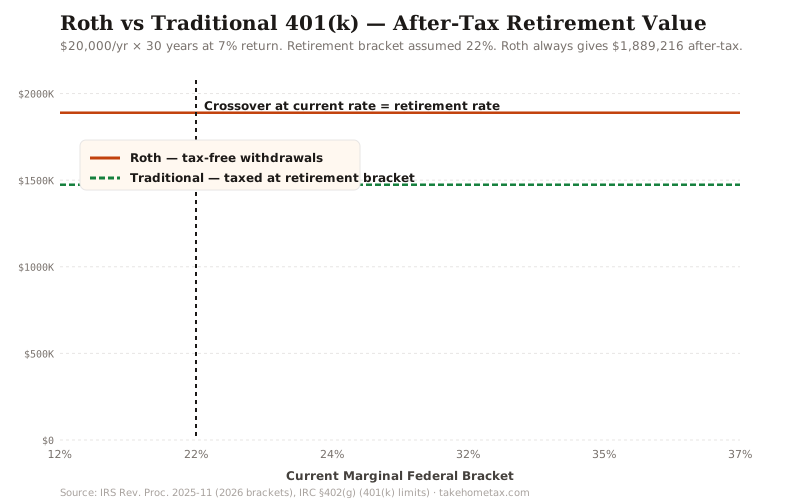
The Roth vs Traditional 401(k) decision is one of the most-googled personal finance questions, and most calculators get it wrong by asking you to guess your future tax bracket. The actual math is more nuanced because your retirement marginal rate is driven by the income you'll be drawing — which depends partly on what you choose to do here. Traditional contributions reduce taxable income now and create taxable Required Minimum Distributions later. Roth contributions are taxed now and create tax-free withdrawals later with no RMDs during your lifetime.

The fundamental math: if your marginal tax rate is identical now and in retirement, Traditional and Roth produce mathematically equal after-tax outcomes when the contributions are equivalent in pre-tax terms. The case for Traditional is rate arbitrage — paying tax later at a lower rate. The case for Roth is rate arbitrage in the other direction, plus three structural advantages: no RMDs during your lifetime, tax-free inheritance for heirs under the SECURE Act 10-year rule, and protection from future bracket increases (politically likely as the TCJA cuts sunset).

Most workers should default to Traditional during peak earning years, especially in the 24%, 32%, or 35% federal brackets. The math heavily favors taking the deduction at 35% to pay 22% (or less) on RMDs in retirement when you have no W-2 income. The exception is high savers whose retirement balance will be so large that RMDs push them right back into peak brackets — that's the population for whom Roth becomes more attractive even at high current rates.

This calculator uses the actual 2026 federal tax brackets (IRS Rev. Proc. 2025-11) and computes your true marginal rate at both your current income and projected retirement withdrawal level. The current rate is what you save now via Traditional. The retirement rate is what Traditional withdrawals will actually cost you — including the brackets they push into and your state tax exposure at retirement (which may differ from your state tax exposure today if you plan to relocate).

An optional 'invest the tax savings' mode models the rigorous version of the comparison: Traditional contributor invests the upfront tax savings in a taxable brokerage account, growing at the same return rate, with long-term capital gains tax on the growth at withdrawal. With perfect execution this nearly equalizes Traditional and Roth at the same rate. In reality almost no one does this — most people spend the tax savings — which is why Roth often outperforms in practice even with identical brackets.

What's missing from the simple comparison: RMDs interact with Social Security taxation (the 'tax torpedo') and IRMAA Medicare premium surcharges, creating effective marginal rates 10-20 points higher than the bracket alone suggests. Heirs face the SECURE Act 10-year rule on inherited Traditional 401(k)s, paying tax during their peak earning years. The Roth structure escapes both of these. Run this calculator first for the headline answer, then use the RMD Forecaster and Tax Cliff Map for the full retirement-phase picture.

Frequently Asked Questions

Roth vs Traditional 401(k) — which is better?+
If your current marginal tax rate is higher than your expected retirement rate, Traditional usually wins (deduct at 32%, withdraw at 22% = rate arbitrage in your favor). If your current rate is lower than your expected retirement rate, Roth usually wins (lock in today's rate before brackets rise). At identical rates, the two are mathematically equivalent for equal pre-tax contributions — but Roth tends to win in practice because most people don't invest the tax savings from Traditional, making Roth's forced savings effect a real edge. For workers in the 22-24% bracket who expect modest retirement income, the answer often defaults to Traditional with some Roth diversification.
What is the difference between Roth and Traditional 401(k)?+
Traditional 401(k) contributions are pre-tax: they reduce your taxable income this year, grow tax-deferred, and are taxed as ordinary income on withdrawal in retirement. Roth 401(k) contributions are after-tax: no current deduction, but the money grows tax-free and qualified withdrawals (after 59½ with 5-year account age) are tax-free. Both have the same employee deferral limit ($23,500 in 2026, $31,000 with catch-up at 50+, $34,750 with super catch-up at 60-63). Employer matching contributions go to the Traditional side regardless of which type you elect, unless your plan allows Roth matching (which became permitted under SECURE Act 2.0 and is rolling out across employers).
Can I contribute to both Roth and Traditional 401(k)?+
Yes, and many planners recommend split contributions for tax diversification — typically 50/50 or weighted toward Traditional during peak earning years. The combined contribution limit is $23,500 in 2026 ($31,000 with age-50 catch-up, $34,750 with age 60-63 super catch-up under SECURE 2.0). You can split that limit any way you want between Roth and Traditional within the same plan. Splitting creates valuable tax flexibility in retirement: in low-income years draw from Traditional, in high-income years draw from Roth. The split also hedges against tax rate uncertainty — if rates rise more than expected, the Roth portion shines; if you retire to a no-tax state, the Traditional portion benefits from rate arbitrage.
Should high earners use a Roth 401(k)?+
Counterintuitively, often yes — at least partially. The traditional advice (high earner = Traditional only) misses three factors: (1) future tax brackets are likely to rise as TCJA cuts expire and federal deficits grow; (2) RMDs from large Traditional balances push retirees into bracket creep territory at 73-75; (3) the Roth has no RMD requirement and passes to heirs tax-free under the SECURE Act 10-year rule. High earners with multi-million-dollar retirement balances often end up in 32-35% brackets in retirement regardless. A 50/50 Roth/Traditional split for top earners hedges against this.
Do employer matches go to Roth 401(k)?+
Traditionally no — employer matching contributions went to a pre-tax sub-account regardless of which type the employee chose. SECURE Act 2.0 §604 permits employers to offer Roth matching starting in 2023, but plans must update their documents to allow it. Roth matching is gaining adoption but isn't yet universal. If your employer matches to Traditional only, you can still contribute to Roth 401(k) on the employee side — your contributions are Roth, the match is Traditional, and you end up with both buckets without changing the total contribution.

More Tax Tools

PaycheckFreelance TaxOvertime (OBBBA)Quarterly EstimatesBonus TaxW-4 WithholdingTax RefundStock OptionsRSU TaxSelf-EmploymentSide IncomeRetirementSalary → HourlyHourly → SalaryMarriage TaxRelocationCost of LivingEmployer CostCapital Gains1099 vs W2Social SecurityPaycheck PlannerSalary NegotiationRetirement PlannerBracket VisualizerSide HustleTotal CompAMT TriggerCharitable GivingWithdrawal SequencerTrue Marginal RateTax Cliff MapRMD ForecasterSS Claiming AgeLump Sum vs AnnuityInherited IRARMDInflation SalaryHSA Triple-Tax
Sponsored
Recommended Reading
Disclosure
Retirement Financial Planning Guidebook
by Gordon Wells
Plain-language walkthrough of building retirement security — savings strategies, withdrawal timing, and avoiding common late-career mistakes.
View on Amazon →
Retirement Planning Guidebook
by Wade Pfau, PhD
Researcher-grade reference on the entire retirement-income decision: Social Security claiming, withdrawal rates, annuities, tax-efficient sequencing.
View on Amazon →
Living Trusts, Retirement & Estate Planning
by Estate Planning Guide
Step-by-step on integrating retirement accounts with living trusts, beneficiary designations, and inheritance tax planning.
View on Amazon →
The Take-Home Tax Guide
Weekly tips on reducing your tax burden, state tax changes, and salary negotiation strategies. Free.