Wednesday, October 21, 2026·2026 Edition
AboutMethodologyContact
The TakeHomeTax
Home/Calculators/Relocation Calculators
Relocation Calculators

Relocation Tax Calculator

Calculate how much you save or lose by moving to a different state. Compare take-home pay, cost of living, and 5-year projections.

By Jacob McEwen·Updated for 2026 tax year·Editorial standards
Modern suburban home for relocation — representing state-to-state take-home pay comparison and 5-year cumulative tax savings
Photo by Tierra Mallorca on Unsplash
Interactive Calculator

All inputs adjust the result in real time. No data leaves your browser.
Tax Year
$
Annual Savings Moving to Texas
+$5,327$5K/year more
Moving from California to Texas at $100,000 salary
California Take-Home
$73,798
26.2% effective
Texas Take-Home
$79,125
20.9% effective
5-Year Savings
+$26,636
Cost-Adjusted Value
$85,081
at 93 cost index
California
State Tax Rate1-13.3%
Federal Tax$13,225
FICA$7,650
State + Local Tax$5,327
Total Taxes$26,202
Take-Home$73,798
Monthly$6,150
Cost of Living Index142
Cost-Adjusted Take-Home$51,970
TexasLower Tax
State Tax RateNone
Federal Tax$13,225
FICA$7,650
State + Local Tax$0
Total Taxes$20,875
Take-Home$79,125
Monthly$6,594
Cost of Living Index93
Cost-Adjusted Take-Home$85,081
Equivalent Salary
To maintain the same purchasing power as $100,000 in California, you would need to earn:
$57,500 in Texas
You need $43K less in Texas
Sponsored
Disclosure
Relocating? Get AI-Powered Market Insights
Homesage.ai analyzes 140 million properties — compare price-to-income ratios, market trends, and value-vs-tax-burden by neighborhood when planning a move.
Analyze Markets →
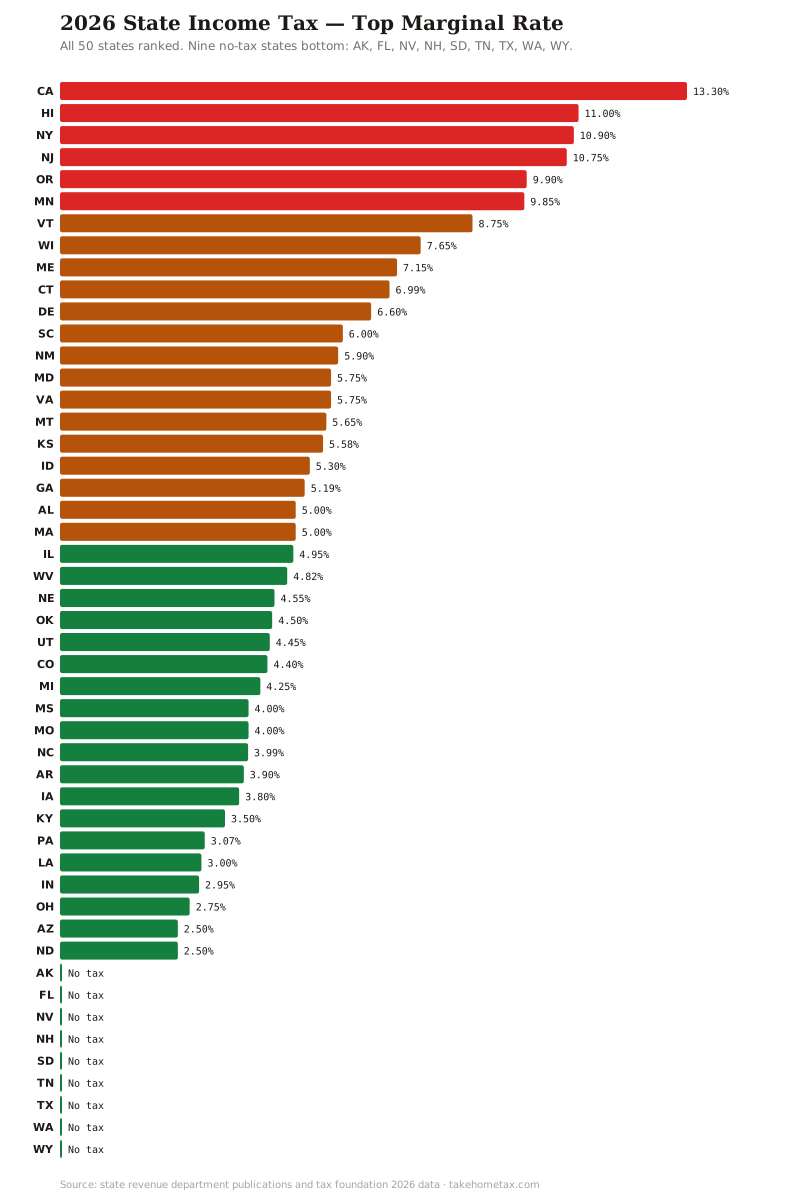
Top marginal state income tax rate by state for 2026 ranked from California's 13.3% down to nine no-income-tax states
Figure. Top marginal state income tax rates in 2026, ranked. The gap between California's 13.3% and the no-tax states is the single largest geographic tax arbitrage available to US workers. — Source: State revenue department publications, 2026
The Background

State income taxes vary dramatically across the US. Nine states have no income tax at all, while states like California charge up to 13.3%. Moving from a high-tax state to a low-tax state can save thousands per year in take-home pay.

However, tax savings alone do not tell the full story. Cost of living varies significantly between states. A higher take-home in Texas may not go as far as a lower take-home in Mississippi, where housing and goods cost less. This calculator adjusts for cost of living using state-level cost indices.

The equivalent salary calculation shows what you would need to earn in the target state to maintain the same purchasing power you have today. This accounts for both tax differences and cost-of-living differences between the two states.

The 5-year cumulative projection gives you a sense of the long-term financial impact. Remember that actual savings depend on many factors including property taxes, sales taxes, and specific local costs that vary within each state.

Related Guides
Moving States to Save on Taxes: The Definitive 2026 Guide
How to Use Tax Data to Negotiate a Better Salary
Estimated Tax Safe Harbor 2026: Pay 100% (or 110%) of Last Year's Tax
Marriage and Taxes: The Complete Planning Guide for 2026
Frequently Asked
How much do I save by moving to a no-income-tax state?+
The state income tax you currently pay, which at $100,000 is about $5,300 in California, $4,900 in New York, $4,800 in Illinois and $8,200 in Oregon in 2026, and roughly double those at $200,000. Nine states have no wage tax: Alaska, Florida, Nevada, New Hampshire, South Dakota, Tennessee, Texas, Washington and Wyoming. Property and sales taxes in those states claw some of it back.
Does the calculator include cost of living?+
Yes. The cost-adjusted line divides take-home by each state's price index, so a move from a high-tax, high-cost state to a low-tax, low-cost one shows the full gain, while a move to a no-tax state with expensive housing — Washington, New Hampshire — shows that prices absorb part of the tax saving. The five-year figure compounds the annual difference.
Will my old state still tax me after I move?+
Only on income earned there after the move, with two exceptions. New York, Delaware, Nebraska and Pennsylvania apply a convenience-of-the-employer rule: a remote employee of a company based there can owe that state's tax even while living elsewhere. And a move only counts once domicile genuinely changes — driver's license, voter registration, primary home, days present — which California and New York audit.
When does a move for tax reasons make sense?+
When the annual state saving exceeds the cost and disruption of moving and is not eaten by housing. Below about $75,000 the saving is usually $1,000 to $3,000 and housing dominates; between $150,000 and $250,000 it reaches $8,000 to $20,000 a year; above that it is five figures every year. Remote workers and retirees, who carry their income with them, see the cleanest gain.
What about moving in the middle of a year?+
You file part-year returns in both states, each taxing the income earned while you lived there. Wages are split by pay date; a bonus or stock vest is generally taxed by the state where you lived when it was earned, which some states measure by work days. Moving before a large vest or sale, and documenting the date, is the single most valuable timing decision.
More in Relocation Calculators
Browse all relocation calculators →
The Full Index
PaycheckNet PayFreelance TaxOvertime (OBBBA)Quarterly EstimatesBonus TaxW-4 WithholdingTax RefundStock OptionsRSU TaxSelf-EmploymentSide IncomeRetirement401(k) WithdrawalIRA WithdrawalSalary → HourlyHourly → SalaryMarriage TaxCost of LivingEmployer CostCapital Gains1099 vs W2Social SecurityPaycheck PlannerSalary NegotiationRetirement PlannerBracket VisualizerSide HustleTotal CompAMT TriggerCharitable GivingWithdrawal SequencerTrue Marginal RateTax Cliff MapRMD ForecasterSS Claiming AgeLump Sum vs AnnuityInherited IRARMDInflation SalaryRoth vs Traditional 401kHSA Triple-Tax401(k)
Was this calculator helpful?
The Take-Home Tax Guide
Weekly tips on reducing your tax burden, state tax changes, and salary negotiation strategies. Free.