Social Security Tax Calculator
Calculate how much of your Social Security benefits are taxable at the federal and state level. See the 0%, 50%, and 85% thresholds and compare all 50 states.

All inputs adjust the result in real time. No data leaves your browser.
All 50 States Comparison
Ranked by net Social Security benefit based on $24,000/year in benefits and $30,000 other income (single).
| # | State | State Taxes SS? | Net Annual Benefit | Effective Rate |
|---|---|---|---|---|
| 1 | Alabama | No | $22,644 | 5.7% |
| 2 | Alaska | No | $22,644 | 5.7% |
| 3 | Arizona | No | $22,644 | 5.7% |
| 4 | Arkansas | No | $22,644 | 5.7% |
| 5 | California | No | $22,644 | 5.7% |
| 6 | Colorado | Yes | $22,644 | 5.7% |
| 7 | Delaware | No | $22,644 | 5.7% |
| 8 | Florida | No | $22,644 | 5.7% |
| 9 | Georgia | No | $22,644 | 5.7% |
| 10 | Hawaii | No | $22,644 | 5.7% |
| 11 | Idaho | No | $22,644 | 5.7% |
| 12 | Illinois | No | $22,644 | 5.7% |
| 13 | Indiana | No | $22,644 | 5.7% |
| 14 | Iowa | No | $22,644 | 5.7% |
| 15 | Kansas | Yes | $22,644 | 5.7% |
| 16 | Kentucky | No | $22,644 | 5.7% |
| 17 | Louisiana | No | $22,644 | 5.7% |
| 18 | Maine | No | $22,644 | 5.7% |
| 19 | Maryland | No | $22,644 | 5.7% |
| 20 | Massachusetts | No | $22,644 | 5.7% |
| 21 | Michigan | No | $22,644 | 5.7% |
| 22 | Minnesota | Yes | $22,644 | 5.7% |
| 23 | Mississippi | No | $22,644 | 5.7% |
| 24 | Missouri | Yes | $22,644 | 5.7% |
| 25 | Montana | Yes | $22,644 | 5.7% |
| 26 | Nevada | No | $22,644 | 5.7% |
| 27 | New Hampshire | No | $22,644 | 5.7% |
| 28 | New Jersey | No | $22,644 | 5.7% |
| 29 | New Mexico | Yes | $22,644 | 5.7% |
| 30 | New York | No | $22,644 | 5.7% |
| 31 | North Carolina | No | $22,644 | 5.7% |
| 32 | North Dakota | No | $22,644 | 5.7% |
| 33 | Ohio | No | $22,644 | 5.7% |
| 34 | Oklahoma | No | $22,644 | 5.7% |
| 35 | Oregon | No | $22,644 | 5.7% |
| 36 | Pennsylvania | No | $22,644 | 5.7% |
| 37 | South Carolina | No | $22,644 | 5.7% |
| 38 | South Dakota | No | $22,644 | 5.7% |
| 39 | Tennessee | No | $22,644 | 5.7% |
| 40 | TexasYou | No | $22,644 | 5.7% |
| 41 | Vermont | Yes | $22,644 | 5.7% |
| 42 | Virginia | No | $22,644 | 5.7% |
| 43 | Washington | No | $22,644 | 5.7% |
| 44 | Wisconsin | No | $22,644 | 5.7% |
| 45 | Wyoming | No | $22,644 | 5.7% |
| 46 | Rhode Island | Yes | $22,629 | 5.7% |
| 47 | Nebraska | Yes | $22,571 | 6.0% |
| 48 | West Virginia | Yes | $22,438 | 6.5% |
| 49 | Connecticut | Yes | $22,386 | 6.7% |
| 50 | Utah | Yes | $22,141 | 7.7% |
Frequently Asked Questions
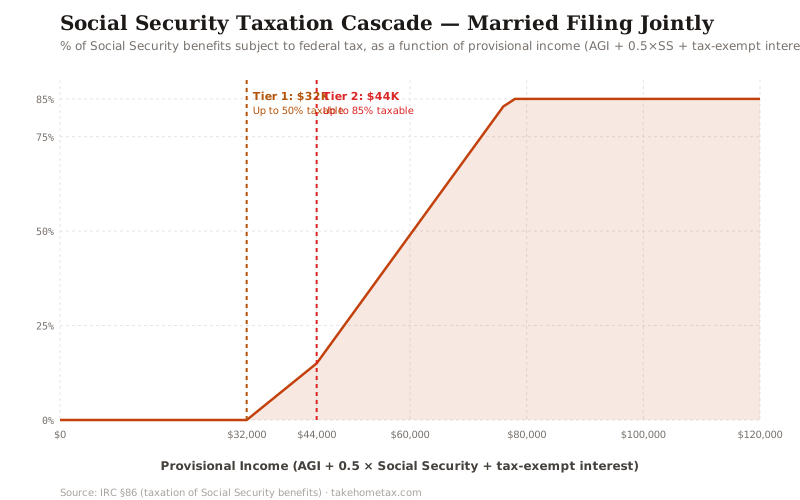
Social Security benefits are taxed at the federal level based on your provisional income, sometimes called combined income. Provisional income equals your adjusted gross income (excluding Social Security) plus any nontaxable interest plus one-half of your Social Security benefits. This formula determines whether 0%, up to 50%, or up to 85% of your benefits are subject to federal income tax. The key thresholds are $25,000 and $34,000 for single filers, and $32,000 and $44,000 for married couples filing jointly.
If your provisional income falls below the lower threshold, none of your Social Security is taxable. Between the lower and upper thresholds, the taxable portion is the lesser of 50% of your benefits or 50% of the amount by which your provisional income exceeds the lower threshold. Above the upper threshold, the calculation becomes more complex: you take 85% of the excess above the upper threshold, add the smaller of 50% of your benefits or 50% of the gap between the two thresholds, and cap the result at 85% of your total benefits. This means at least 15% of your Social Security will always be tax-free federally.
At the state level, most states do not tax Social Security benefits at all. However, approximately 12 states impose some form of taxation on Social Security income as of 2026: Colorado, Connecticut, Kansas, Minnesota, Missouri, Montana, Nebraska, New Mexico, Rhode Island, Utah, Vermont, and West Virginia. Each state applies different rules, with many offering income-based exemptions. For example, Colorado exempts Social Security for taxpayers with AGI below $75,000 (single) or $95,000 (married), while Vermont begins taxing at $50,000 (single) or $65,000 (married). Several states including Nebraska and West Virginia are actively phasing out Social Security taxation.
One of the most misunderstood concepts in retirement tax planning is the Social Security tax torpedo. This occurs in the income range where each additional dollar of other income causes $0.50 or even $0.85 of Social Security benefits to become taxable. In the 50% zone, a dollar of pension income effectively creates $1.50 of taxable income, boosting your marginal tax rate by 50%. In the 85% zone, that same dollar creates $1.85 of taxable income. If you are in the 22% federal bracket, your effective marginal rate on that pension dollar is actually 22% times 1.85, which is about 40.7%. This tax torpedo makes the provisional income range between $25,000 and $44,000 (single) or $32,000 and $60,000 (married) especially important to plan around.
Several strategies can help minimize taxation of your Social Security benefits. Roth IRA conversions done before you start collecting Social Security are particularly powerful because Roth withdrawals do not count toward provisional income. Converting traditional IRA balances to Roth in your 60s, before Social Security begins, can dramatically lower your tax burden in later retirement years. Municipal bond interest, while technically included in provisional income under federal rules, can still offer state tax advantages. Careful timing of retirement account withdrawals, capital gains, and other income events around the Social Security thresholds can also produce meaningful tax savings.
When choosing where to retire, state taxation of Social Security is an important factor but not the only one. States like Florida, Texas, Wyoming, and Nevada have no income tax at all, meaning zero state tax on any retirement income. Among states that do have income taxes, most exempt Social Security entirely. The roughly dozen states that tax Social Security typically offer generous exemptions that shield moderate-income retirees. For high-income retirees in states like Minnesota or Vermont, the state tax on Social Security can add 3% to 6% in effective taxation on benefits. Use the 50-state comparison table below to see exactly how your Social Security would be taxed in every state based on your specific income and filing status.