Social Security Claiming Age Optimizer
Compare lifetime Social Security benefits at every claiming age from 62 to 70 using actual SSA reduction and delayed retirement credit formulas. Includes federal SS taxation cascade and break-even analysis.

All inputs adjust the result in real time. No data leaves your browser.
Claiming-Age Comparison
| Claim Age | % of PIA | Monthly | Annual | Lifetime (nominal) | Lifetime After Tax | NPV After Tax |
|---|---|---|---|---|---|---|
| 62 | 70.0% | $1,960 | $23,520 | $761K | $722K | $507K |
| 63 | 75.0% | $2,100 | $25,200 | $771K | $732K | $506K |
| 64 | 80.0% | $2,240 | $26,880 | $776K | $737K | $503K |
| 65 | 86.7% | $2,427 | $29,120 | $792K | $752K | $506K |
| 66 | 93.3% | $2,613 | $31,360 | $801K | $761K | $505K |
| 67 | 100.0% | $2,800 | $33,600 | $805K | $764K | $501K |
| 68 | 108.0% | $3,024 | $36,288 | $812K | $771K | $499K |
| 69 | 116.0% | $3,248 | $38,976 | $813K | $772K | $492K |
| 70 | 124.0% | $3,472 | $41,664 | $807K | $767K | $482K |
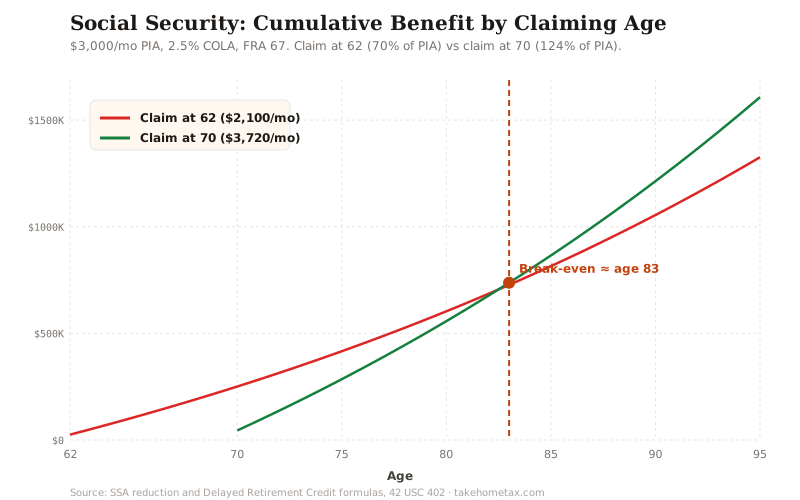
When you claim Social Security determines your benefit for life. Each month early reduces the check; each month delayed past Full Retirement Age (FRA) increases it. Your Full Retirement Age depends on birth year: born 1960 or later means FRA is 67. The formulas come directly from Social Security Act Section 202 (42 USC 402).
The reduction for claiming early: 5/9 of 1% per month for the first 36 months before FRA, then 5/12 of 1% per month for any additional early months. Claiming exactly at 62 with FRA of 67 cuts your monthly check by 30% — permanently. The delayed retirement credit going past FRA is 2/3 of 1% per month (8% per year), maxing out at age 70.
Three numbers matter: monthly benefit at claim, lifetime total received, and present value. Lifetime totals always favor delayed claiming if you live long enough; the relevant question is when the 70-claim catches up to the 62-claim. That break-even age for someone with FRA 67 typically lands between 80 and 83, depending on COLA assumptions and the discount rate you apply.
The federal taxation cascade adds another layer. Up to 85% of Social Security benefits become taxable when 'provisional income' (other income + half of SS) exceeds $32,000 married / $25,000 single for the first tier and $44,000 / $34,000 for the second tier. This calculator computes the actual federal tax owed on each year's benefit and projects after-tax lifetime totals — both nominal and discounted to present value.
This is not advice on when to claim. It models the math. Health status, marital status (spousal/survivor benefits), other income sources, longevity in your family, and whether you need the money now all matter beyond what any calculator captures. Use the break-even age and NPV columns to inform the decision, not make it.