401(k) Calculator
Calculate your 2026 401(k) tax savings, employer match value, and projected retirement balance using actual IRS contribution limits — including the SECURE 2.0 Act super catch-up for ages 60-63 and the §415(c) overall contribution cap.

All inputs adjust the result in real time. No data leaves your browser.
Year-by-Year Balance Projection
| Year | Age | Salary | Your Contribution | Employer Match | End-of-Year Balance |
|---|---|---|---|---|---|
| 1 | 35 | $100K | $10,000 | $3,000 | $14K |
| 3 | 37 | $105K | $10,506 | $3,152 | $46K |
| 5 | 39 | $110K | $11,038 | $3,311 | $84K |
| 7 | 41 | $116K | $11,597 | $3,479 | $129K |
| 9 | 43 | $122K | $12,184 | $3,655 | $182K |
| 11 | 45 | $128K | $12,801 | $3,840 | $245K |
| 13 | 47 | $134K | $13,449 | $4,035 | $319K |
| 15 | 49 | $141K | $14,130 | $4,239 | $405K |
| 17 | 51 | $148K | $14,845 | $4,454 | $506K |
| 19 | 53 | $156K | $15,597 | $4,679 | $624K |
| 21 | 55 | $164K | $16,386 | $4,916 | $761K |
| 23 | 57 | $172K | $17,216 | $5,165 | $920K |
| 25 | 59 | $181K | $18,087 | $5,426 | $1.1M |
| 27 | 61 | $190K | $19,003 | $5,701 | $1.3M |
| 29 | 63 | $200K | $19,965 | $5,989 | $1.6M |
| 30 | 64 | $205K | $20,464 | $6,139 | $1.7M |
A 401(k) is the most common employer-sponsored retirement plan in the United States. Employee contributions reduce taxable income in the year of contribution, grow tax-deferred while invested, and are taxed as ordinary income upon withdrawal in retirement. This calculator models the full lifecycle — annual tax savings during accumulation, employer match capture, year-by-year balance growth, and projected retirement value — using the actual 2026 IRS contribution limits.
The 2026 employee contribution limit is $24,500 per IRS Notice 2025-67. Workers age 50 and older can add an $8,000 catch-up contribution for a $32,500 total. SECURE Act 2.0 §109 introduced a 'super catch-up' for workers age 60, 61, 62, and 63 — they can add $11,250 instead of $8,000, bringing their total to $35,750. The super catch-up reverts to the regular $8,000 catch-up at age 64. The overall §415(c) cap on employee plus employer contributions combined is $72,000 in 2026 ($80,000 with catch-up, $83,250 with super catch-up).
The employer match is the single most important variable for most workers. A typical match is 50% of contributions up to 6% of salary — meaning if you contribute 6% of pay, the employer adds 3% of pay. On a $100,000 salary, that's $6,000 employee + $3,000 employer = $9,000 going into your 401(k) annually before any tax savings. Contributing below the match cap leaves free money on the table. This calculator highlights any unclaimed match and shows the immediate dollar value.
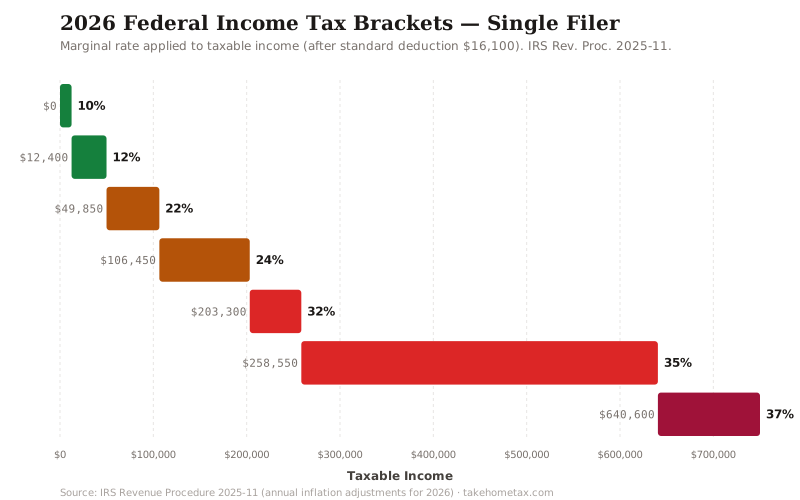
Tax savings happen at your marginal federal rate plus state rate (where applicable). A worker in the 24% federal bracket plus 5% state contributing $20,000 saves $5,800 in current-year taxes — money that stays in your paycheck rather than going to taxes. Over a 30-year career, those annual savings compound to six-figure totals. Note that 401(k) contributions reduce income tax but NOT Social Security or Medicare tax (FICA), which is paid on the full gross wage. HSAs via payroll are the only common pre-tax account that also avoids FICA.
The retirement balance projection uses standard compound growth assumptions: annual contributions invested at your specified return rate, with optional annual salary raises driving slightly higher contributions each year. Real-world returns will differ from any projection — markets are volatile, sequence-of-returns risk matters, and inflation erodes purchasing power. Use the projection as a directional planning anchor rather than a precise prediction. For more sophisticated retirement modeling that includes Social Security, RMDs, and withdrawal sequencing, use the Retirement Income Planner.
Whether to contribute to a Traditional 401(k) or Roth 401(k) is a separate decision driven by rate arbitrage — current marginal rate versus expected retirement rate. The Roth vs Traditional 401(k) Calculator on this site walks through that math with real federal brackets. If your employer offers a Roth 401(k) option and you expect to be in a higher tax bracket in retirement (common for early-career savers), consider routing at least part of your contributions to the Roth side. The employee contribution limit applies across both buckets combined.